Every year, millions of our tax dollars are sent directly to US multinationals for software licenses.
This does not create jobs here, nor expertise or a basis for building other solutions.
The only statistic I found was that in “2012, the Quebec government spent $1.4 billion renewing proprietary licenses, but could have saved at least $265 million by choosing open source software.” Source : Le Soleil
Yet free, open and often even superior solutions remain ignored or ridiculed.
Why continue to finance our technological dependence with public money when we could be strengthening our digital independence and encouraging Quebec-based programmers and companies?
In Quebec, we seem to be continuing with the same method, which often fails. We’re constantly reinventing the wheel. I believe that with free software we could reuse what works to keep moving forward, while creating jobs and innovation.
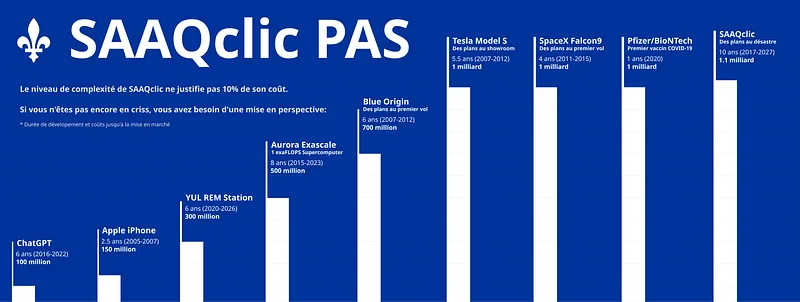
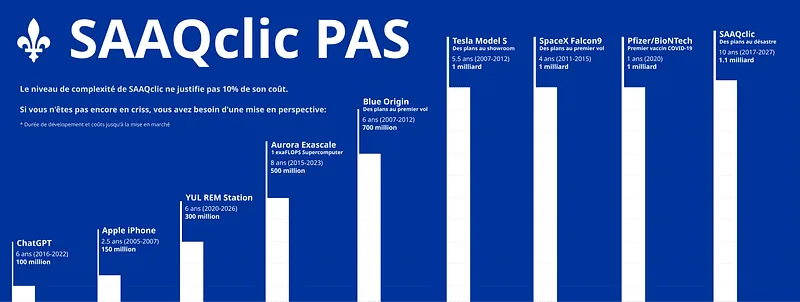
Example of a project that costs too much in Quebec
Among the innovative companies, I’m thinking of Savoir-faire Linux, which has been developing open-source solutions for years.
Those who know me will know that I’m a staunch defender of free world ideas. So I was delighted to see this new :
*“The UN Open Source community is proud to announce that 16 major organizations have adopted the UN Open Source Principles, following initial endorsement by the Open Source Initiative (OSI), bringing the total to 17.” Source: *United Nations – Sixteen organizations endorse UN Open Source Principles
Once again, I asked myself, why isn’t this encouraged in Quebec?
And yet, free software projects do exist in Quebec. There’s even the Quebec government’s ” Cadre de référence des logiciels libres “, published in 2021, which reports on the progress of open-source software use in Quebec’s public sector, and lists the most common initiatives and software.
For example, the IGO (Open Geomatics Infrastructure) project and the Government Forge are good examples of efforts to integrate Open Source into public institutions.
Despite these good projects, proprietary software still dominates. It seems that many administrators still prefer to pay the high price out of habit, fear of change, or simply ignorance of existing alternatives.
Another successful case in Quebec is that of the Commission des transports, which developed the Système intégré de mission (SIM) with CGI on an open-source basis. Thanks to this project, it has become one of the first administrative tribunals in Quebec to operate without paper. As a result, files are processed faster, waiting times are reduced and, above all, substantial savings are made in management and maintenance costs.(source)
Savings?
The studies are clear: the savings possible with free software are substantial and real. Elsewhere in the world, there are examples that speak for themselves
- Estonia: The national e-health program cost $10 million, while ensuring citizens’ digital sovereignty.
- Ukraine: In the midst of war, they digitized their civil registry and created a national digital identity. Their application, Diia, is open on GitHub.
- Ville de Paris: Public works are managed with the Lutèce suite, which is 100% open source, multilingual, and all code is public.
- Catalonia: Decidim, a free citizens’ platform, allows everyone to comment and vote on laws online.
- Federal Germany: uses Nextcloudfor document sharing and management.
- ONU: Uses CryptPad for secure collaborative documents.
- French Gendarmerie and the Land of Schleswig-Holstein (Germany): migrate to Linux desktops on a large scale.
- Switzerland and Canton of Berne: demand open source software in all new public contracts.
- China: Central government uses a customized version of Ubuntu Linux(Kylin).
We can do things differently, with free software, for up to 50 times less, while developing our expertise and remaining independent.
Beware, free software doesn’t mean free or at no cost. You need to plan for people’s adjustment and training!
According to a CEFRIO study (2018), only 13% of public organizations in Quebec were primarily using open-source software in their IT infrastructure, whereas the savings potential is estimated at several tens of millions per year for the administration as a whole(IRIS and CEFRIO).According to the Institut de recherche et d’informations socioéconomiques (IRIS), the widespread adoption of open-source software in Quebec could generate significant savings while improving our technological autonomy.
On an international scale, Munich has saved tens of millions of euros by migrating to open-source solutions such as Linux and LibreOffice. Although this project has had its difficulties, it remains a concrete example that change is not only possible, but beneficial.
Another myth is that free software is “less beautiful” or less user-friendly.
This was sometimes true 20 years ago. Today, tools such as LibreOffice, OnlyOffice, Nextcloud or GIMP offer a polished user experience, adapted to modern office automation. Several major institutions, including the French Gendarmerie Nationale and the City of Barcelona, have migrated to these tools, proving their robustness on a daily basis.
Governance, sustainability, security and digital sovereignty
Well-adopted open-source software, maintained by a recognized community or foundation (such as the Linux Foundation, Apache Software Foundation), benefits from long-term maintenance and transparency superior to many proprietary products.
Many companies and governments have experienced the nightmare of a proprietary supplier abandoning a product without warning, leaving systems obsolete or forcing an even more costly migration.
The Canadian government itself recognizes the strategic importance of free software, contributing to open source projects and publishing its own code under a free license(Government of Canada).
Because depending entirely on foreign proprietary software means placing our data and critical infrastructures under the direct or indirect control of foreign powers.
From a security point of view, it is clear that there are risks in continuing to remain dependent:
- Total dependence on the supplier: Impossible to change supplier without astronomical costs.
- Unpredictable cost increases: total supplier control over pricing and conditions of use.
- Invisible security holes: Closed source code that prevents proactive identification of vulnerabilities.
On the security side, code transparency is a strength: major flaws are often spotted and corrected very quickly, as was the case with the Heartbleed vulnerability in OpenSSL (2014), where the global community mobilized in a matter of hours.
In proprietary software, a flaw can lie dormant for months without being detected or corrected.
Advantages of free software
- Transparency: source code can be audited and secured.
- Significant reduction in recurring costs: No license fees.
- Technological independence: freedom to modify, adapt and customize tools to the precise needs of each organization.
Circular knowledge economy
Relying on open source software means creating a circular economy of innovation, since code developed for one city or ministry can be reused, improved and redeployed elsewhere, creating a shared investment and leverage effect for all.
Accessibility, francization and adaptation
Open-source software makes it possible to quickly adapt tools to Quebec’s cultural, linguistic and regulatory needs.
We can ensure complete francization, accessibility for all and compliance with public procurement standards, without depending on the deadlines or priorities of a foreign supplier.
“Green IT and digital sobriety
Open source software is also an eco-responsible approach, with solutions that consume less power, optimize existing hardware, pool infrastructures and limit electronic waste.
Choosing open source also means reducing the carbon footprint of public organizations.
The shift to artificial intelligence
It’s impossible to talk about technology without mentioning artificial intelligence. Today, the majority of major AI tools such as TensorFlow, PyTorch, HuggingFace and Scikit-learn are open-source, with extremely dynamic international communities.
If Quebec wants to play an important role in this field, I believe that adopting the “free” reflex now will avoid being left behind on the next technological wave.
So why isn’t it increasing?
Adopting free software isn’t always easy.
The Munich case also shows why some migrations fail, due to a lack of training, end-user resistance to change, incompatibility with certain other proprietary systems and, above all, constant political pressure from proprietary software suppliers.
During the roll-out of the solutions in Munich, employees reported difficulties in adapting their workflows, resulting in significant delays and frustration.
We understand that the success of a migration depends on change management, user support and, above all, firm, consistent political and technical backing throughout the process.
In Quebec, we can also point to cases where the adoption of free software has failed, often due to a lack of political vision or support.
Several ministries have tried to migrate to open-source alternatives without sufficient training or support from management. The result is the same: a return to proprietary solutions, often under pressure from users or suppliers.
It’s not the software’s fault, it’s a question of governance, planning and will.
Legal aspects not to be overlooked
Free software comes with specific licenses(GPL, MIT, Apache) that impose certain obligations, such as the free redistribution of any modifications made.
Managing these licenses is crucial to avoid legal problems. However, these risks are minor compared to the constraints often imposed by restrictive and costly proprietary contracts.
Some practical recommendations for a successful transition
- Serious assessment of internal needs: Clearly identify where OSS can advantageously replace proprietary software. To facilitate this assessment, it is important to use precise indicators such as the frequency of software use, the recurring costs associated with proprietary licenses, the criticality of the data processed, the ease of integration with existing systems and the potential opportunities for improving or customizing the software according to the organization’s specific needs.
- Targeted, ongoing training: Invest in technical and user training to facilitate adoption of new tools. Training is a key element in effectively managing organizational change and reducing user resistance to new software, as shown by several studies on change management(Kotter and Prosci).
- Development of a clear, incentive-based policy: officially promote the use of open-source software in all public tenders. Sometimes, it’s not necessarily the visible application that needs to be replaced by OSS, but rather the databases or back-end tools. Using open models for these infrastructures ensures greater flexibility and independence.
- Partnerships with specialized local companies: Encourage the local economy by supporting a number of Quebec-based developers and companies specializing in open source software. It’s important to involve a variety of local players to avoid falling into the trap of dependence on a single supplier, thus ensuring healthy competition and greater technological resilience.
Pitfalls to avoid
- Replace proprietary software with open-source without reviewing internal processes.
- Neglecting change management (training, support, coaching).
- Believing that a single free supplier is enough: you need to keep several suppliers to avoid recreating dependency.
Successful transition is as much a question of vision as of strategy!
Questions to ask yourself before migrating to free software
- Is the software actively maintained and upgradeable?
- Is there a community or network of experts?
- Is local support available?
- What are my organization’s real needs?
- Do the proposed tools meet legal standards and requirements?
Taking the time to ask yourself these questions is the key to a successful and lasting change of direction.
Long live change!
It’s time to put an end to this costly dependence on foreign technology giants.
By choosing open source software, we’re not only investing in a more transparent and secure technology, but also in a dynamic and innovative local economy.
Quebec deserves better than forever paying for proprietary licenses. It’s time to use our resources to develop free solutions, adapted to our needs, and take full control of our digital future.