Why Vibe Coding Is So Polarizing
Lately we’ve been seeing a new expression: vibe coding.
Vibe coding refers to using generative artificial intelligence tools to produce code from natural-language instructions.
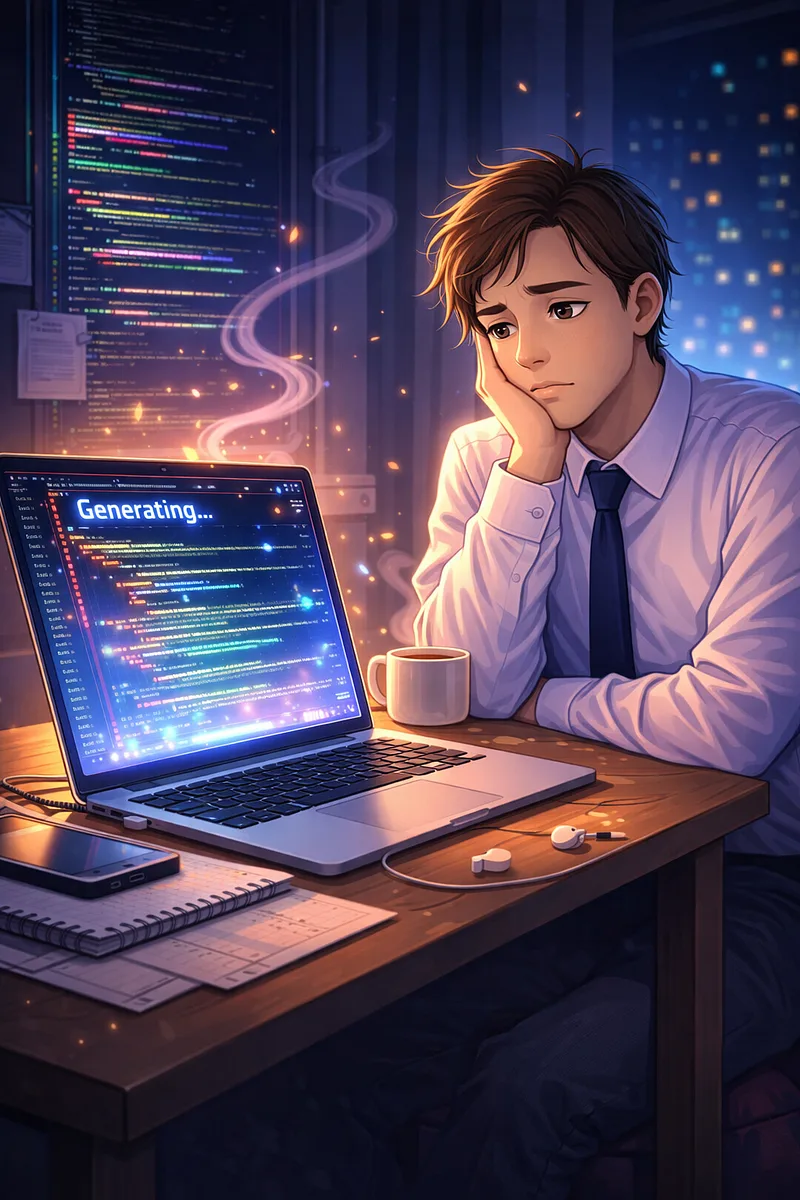
VibeCoding — Created by OpenAI
The human formulates the objective, constraints, and so on. The machine generates the source code for the application.
Some examples of tools: Cursor, Claude Code, GitHub Copilot, OpenAI Codex, Replit Ghostwriter, and Windsurf.
It’s an expression with a double meaning.
In a positive sense, it describes using AI to create software faster.
In a negative sense, it designates someone who produces code without really understanding what they’re doing — like a child making a mess on a wall.
The Advantages
Speed is spectacular. Applications created in minutes. Repetitive tasks can be eliminated.
There is no longer a barrier to entry. One person alone can deliver a project without a team.
For experienced developers, the effect is remarkable. More iterations, more experimentation — they become more productive.
The Limits
What I’ve observed is that the code is uneven, often with errors. For example, the program runs but doesn’t produce the right result. I’ve seen many vulnerabilities, since by default the tool does not perform input validation or complete authentication handling.
So the software may work on the surface, but crashes as soon as you use it for real.
AI tools don’t understand subtext, organizational taboos, implicit limits in our domain, or human sensitivities specific to a sector.
To ask AI to produce good code, you have to be extremely precise about what you want.
The problem is that we often don’t fully understand what we’re asking for ourselves.
Software systems have become so vast and the logic so complex that it’s easy to miss all the implications of our requests and the real impacts of the generated code.
We end up in a spinning wheel: code is produced at high speed, we don’t always fully understand it, and we keep adding new features or fixes. Each addition increases the system’s complexity further.
Why Reactions Are So Strong
Some developers experience this wave as a devaluation. They invested years mastering architectures and concepts. Seeing a machine produce code in seconds hurts professional identity.
Others announce the end of programming. To me, that’s an emotional extrapolation.
In my view, programmers won’t disappear. Their role shifts toward architecture, governance, security, and deep understanding of needs.
The Real Shift in Value
Tools like Claude Code greatly reduce the scarcity of syntactic and implementation work — writing code, memorizing APIs, or solving technical details.
When that part becomes abundant, value shifts to what remains rare.
What becomes rare is no longer writing code, but the ability to correctly define a problem, design an architecture, integrate multiple systems, and ensure production operation.
Three types of expertise become more valuable:
- Architects and strategic thinkers who can decide what to build.
- Integrators and operators who run real systems reliably.
- Business experts who can transform domain knowledge into practical, useful software.
In other words, AI doesn’t replace the best. It increases the value of those with systems thinking, problem decomposition, and critical judgment.
The New Bottleneck
With AI massively increasing code production, it doesn’t necessarily make teams faster.
When generating code becomes easy, teams simply produce more pull requests, more features, and more experiments.
But the critical work remains elsewhere: reviewing code, verifying quality, integrating into existing systems, testing, deploying, and maintaining in production.
The bottleneck therefore shifts to the organizational layer. Code is abundant, but senior developer attention, quality review, and integration into real systems remain scarce.
This creates risks like team fatigue, technical debt accumulation, and production incidents.
That’s why the volume of code created is no longer a relevant productivity indicator. (It never should have been.)
The metrics that matter become deployment frequency, change failure rate, production reliability, and the ability to deliver value without increasing system complexity.
What Is the SaaSpocalypse?
In a TechCrunch article, a founder cited by TechCrunch sent a message to his investor announcing he was replacing his entire customer service team with Claude Code.
Investor Lex Zhao of One Way Ventures saw a much broader signal: if an agent can replace an entire team for certain tasks, it calls into question the role of traditional SaaS software and the logic of buying tools like Salesforce rather than building your own solutions.
The build-versus-buy decision is changing. Software creation is becoming so accessible that building in-house is once again a credible option against giants like Salesforce.
The SaaS model of charging per user is directly threatened. If an agent can do the work of several employees, per-seat pricing no longer makes sense.
SaaS was built on predictable recurring revenue and strong margins. If agents become the primary interface with systems, value could migrate from software to intelligent orchestration.
Markets react violently to every advanced AI tool launch. Some speak of a “SaaSpocalypse.”
In reality, it’s probably a business model shift combined with market overreaction.
An Analogy
The automobile replaced the horse as a method of transport. It didn’t eliminate the need to move.
For me, vibe coding could follow the same trajectory — value doesn’t disappear. It shifts.
Vibe coding is neither the end of programmers nor a passing illusion. It’s a profound transformation in how software is created.
The question now is who will know how to redefine their value in this new environment.