Fear and Trust in AI: People Only See the Chat — But What Is the Rest?
When artificial intelligence comes up in an executive meeting, the image most people form in their minds is ChatGPT. A chat window, a question, an answer.
The problem is that this image is as reductive as judging the automobile from a single visit to a dealership.
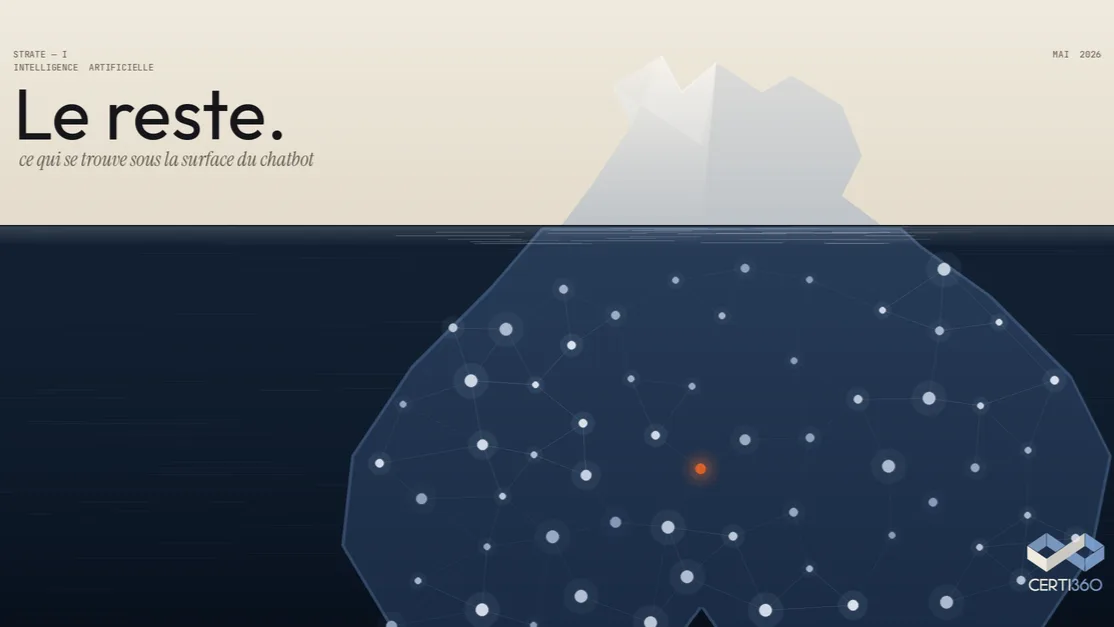
The chatbot is the tip of the iceberg. It’s the most visible interface because it resembles a human conversation. But underneath, there is a whole ecosystem of capabilities that actually change the game for an organization. And it’s that “rest” that should interest an executive — not the chat itself.
The Chatbot Is Only the Surface
A chatbot responds based on what the model learned during training. It doesn’t know your contracts, internal policies, latest financial report, or clients. If you ask it “how many Bill 25 complaints did we receive last month,” it invents or refuses.
That’s where the “rest” comes in. Here are four building blocks that, together, transform AI from a conversation gadget into a business tool.
1. RAG: Making Your Own Documents Speak
RAG stands for Retrieval-Augmented Generation.
The idea is simple. Before answering, the AI searches a document base you provide: policies, procedures, contracts, reports, emails. It then bases its answer on what it finds there, not on its training memories.
Concretely, this is what allows an employee to ask “what is our teleworking policy” and get an answer grounded in YOUR document, with the exact citation.
For a manager, that’s the first real gain. AI becomes an organizational memory that can answer internal questions without drowning everyone in PDFs.
2. Agents: AI That Executes, Not Just Talks
An agent is an AI that no longer just responds. It plans, breaks a task into steps, and executes them.
Concrete example. You tell it: “prepare a summary of yesterday’s meeting, send it to participants, and create follow-up tasks in our project tool.” A chatbot would write a draft. An agent reads the recording, drafts the summary, sends the email, and creates the tasks.
That changes the nature of work. We no longer ask AI to write — we ask it to DO. And yes, that raises security, access rights, and traceability questions that must not be dismissed.
3. MCP: The Universal Connector
MCP, for Model Context Protocol, is an open standard proposed in 2024 by Anthropic and since adopted by several industry players, including OpenAI and Google.
The simplest analogy is USB-C. Before USB-C, every device had its own cable. MCP does the same for AI: a standard protocol that lets a model connect securely to your tools. Your emails, calendar, CRM, file server, ticketing tool.
Without MCP, every integration is a custom project. With MCP, we’re talking about a connector you plug in, configure permissions, and you’re ready.
For an executive, the importance isn’t in the technology. It’s in the strategic question that follows. Which systems do you want AI to access, with what rights and what logging? That looks a lot like access management we already do for humans.
4. Computer Use: AI That Drives the Screen
Last building block, the most recent. AI can now take control of a browser or even a computer. It sees the screen, clicks, types, navigates.
Concretely, this allows automating tasks in software that has no API: filling out a government form, extracting data from a legacy interface, placing an order on a website.
It’s powerful. It’s also risky. If you let AI click on your behalf in your bank portal, you’d better know exactly what it’s allowed to do.
And Fear, in All This?
Fear of AI, in most conversations I have with executives, comes from a misunderstanding. We confuse the demo tool — the chatbot — with industrial reality.
Judging AI on ChatGPT is like judging the Internet on the fact that you once received a phishing email.
Trust is not earned by saying “trust AI.” It’s built with the same tools we use to trust an employee: a clear description of tasks, managed access, action logging, approval controls for sensitive operations, and regular review of what it did.
That’s exactly the reading grid we’ve applied in information security for 25 years. AI is not a special case. It’s a new actor to integrate into the security program.
What to Remember
If your only experience of AI is asking it for a chicken recipe, you’re looking at the end of the dock. The real strategic discussion comes down to four questions:
- Which documents do you want AI to consult? (RAG)
- Which tasks do you want it to execute? (Agents)
- Which systems do you want it to connect to? (MCP)
- Which software do you want it to operate on your behalf? (Computer use)
These four questions are not technical. They are governance questions. As long as an executive doesn’t ask them, they will remain a spectator of a transformation happening anyway, all around them.